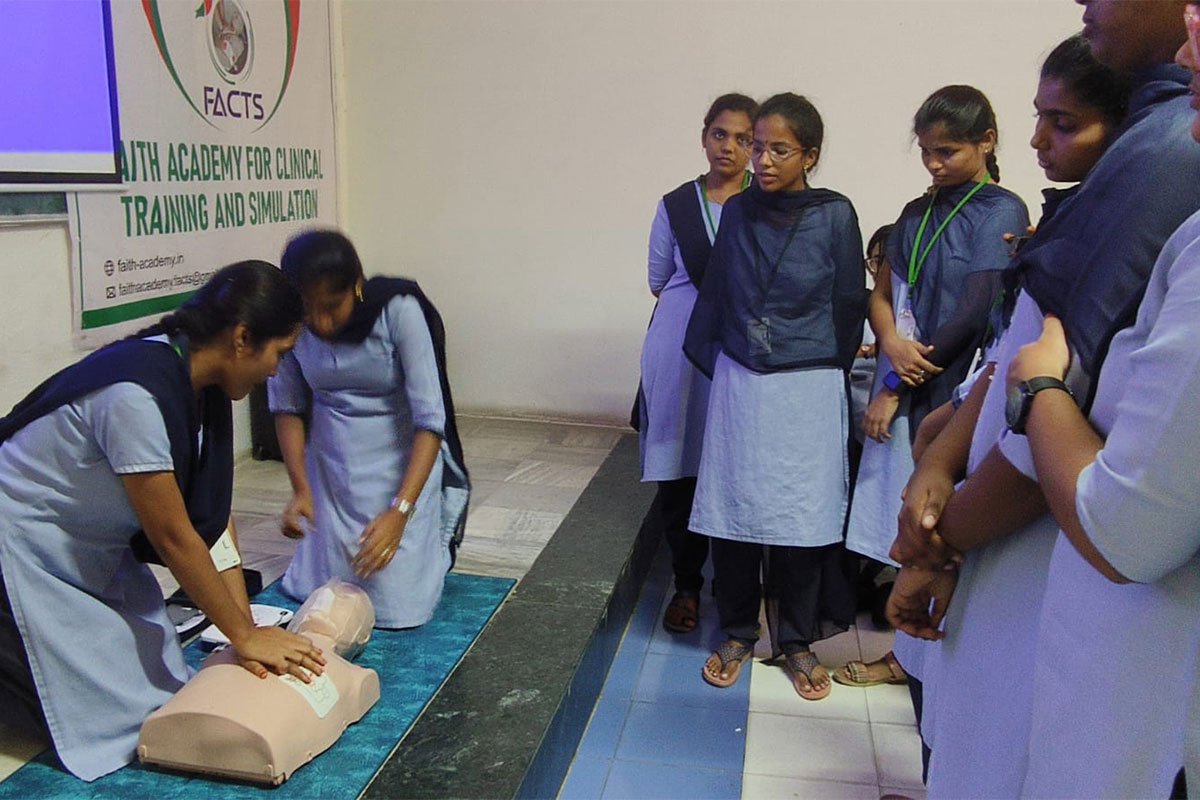
Emergency medicine is one of the most challenging components of healthcare practice. Real-life emergencies demand rapid decision-making, precise technical skills, emotional resilience, and flawless teamwork. The stakes are extraordinarily high — a moment of hesitation, a misinterpreted symptom, or an incorrect intervention can have irreversible consequences. For healthcare students who are still transitioning from theoretical learning to clinical responsibility, being exposed to such high-pressure situations without adequate preparation can be disorienting and potentially dangerous. Simulation training has emerged as a transformative educational strategy that prepares students to face real emergencies safely, confidently, and competently.
Simulation-based learning recreates realistic clinical situations using high-fidelity manikins, virtual and augmented reality environments, mock emergency rooms, and advanced task trainers. These scenarios enable students to apply theoretical knowledge to practical situations, rehearse life-saving procedures, and develop professional behavior — all without putting real patients at risk. As a result, simulation training has become a cornerstone of modern medical and nursing education worldwide.
A controlled space for high-risk skill development
Unlike traditional classroom learning, simulation training offers a risk-free and controlled practice environment. Healthcare emergencies are unpredictable and unforgiving; real patients cannot be used as learning tools. Simulation bridges this ethical and educational gap by providing a setting in which learners can practice life-saving skills — such as airway management, CPR, hemorrhage control, defibrillation, neonatal resuscitation, and emergency drug administration — without fear of causing harm. The opportunity to make mistakes, receive corrective feedback, and repeat procedures until mastery significantly enhances competency before entering the clinical arena.
Sharpening critical thinking and rapid decision-making
Real emergencies require healthcare providers to think critically and act decisively within seconds. Simulation scenarios are intentionally designed to mirror the complexity and urgency of real events, such as:
- acute respiratory distress
- cardiac arrest
- major trauma following accidents
- postpartum hemorrhage
- severe sepsis or shock
- anaphylactic reactions
In these dynamic situations, students must analyze vital signs, identify priorities, evaluate risks, and initiate timely interventions. By repeatedly participating in time-critical simulations, learners develop situational awareness, clinical judgment, and fast yet accurate decision-making — competencies that are essential for emergency care.
Mastery of technical and procedural skills
Effective emergency management is inseparable from technical proficiency. Many procedures cannot be learned through theoretical instruction alone and require hands-on practice. Simulation training provides repeated exposure to core and advanced procedures such as:
- basic and advanced life support (BLS/ACLS)
- intubation and airway management
- vascular access and fluid resuscitation
- trauma stabilization and immobilization
- administration of emergency medications
- use of automated and manual defibrillators
High-fidelity manikins and task trainers replicate real anatomical and physiological responses, enabling students to build muscle memory and fine motor skills — dramatically improving accuracy and performance in real emergencies.
Emotional resilience and stress management
Clinical emergencies are emotionally intense. The combination of time pressure, critical patient conditions, distressed family members, and the unpredictability of complications can overwhelm even experienced practitioners. Simulation training intentionally exposes learners to realistic stressors — flashing alarms, sudden deterioration of vitals, competing priorities, and unexpected complications. Through repeated exposure, students learn to manage stress, regulate emotions, remain focused, and maintain professionalism. This psychological preparedness is invaluable and often determines how efficiently a practitioner can perform during real-life crises.
Strengthening communication and interprofessional collaboration
Emergency care is inherently collaborative. Nurses, doctors, paramedics, pharmacists, and technicians must work together seamlessly and communicate with absolute clarity. Research consistently shows that communication breakdown is a leading cause of medical errors. Simulation provides an excellent platform for interprofessional learning, where learners practice:
- leadership during emergencies
- task delegation and workload distribution
- clear verbal communication and closed-loop reporting
- SBAR-based handovers
- documentation under pressure
These exercises build strong teamwork abilities and reduce the likelihood of error in real clinical settings.
Error prevention and patient safety
One of the main goals of simulation training is to reduce preventable medical errors. After each simulation session, a structured debriefing takes place in which students review their actions, discuss outcomes, and reflect on opportunities for improvement. This reflective learning helps learners internalize protocols, anticipate risks, and avoid repeating mistakes. Through deliberate practice, simulation fosters a culture of safety, caution, and accountability, which directly improves real-world patient outcomes.
Familiarity with modern medical technology
Healthcare systems have become increasingly dependent on advanced equipment and digital tools. Entering an emergency department without experience operating ventilators, infusion pumps, patient monitors, or defibrillators can compromise patient care. Simulation labs integrate modern technology — including smart manikins, virtual reality environments, and digital monitoring systems — enabling students to practice using the same equipment found in clinical institutions. This early exposure builds technological confidence and ensures students are ready for contemporary healthcare environments.
A seamless transition from classroom to clinical practice
For many healthcare students, the leap from textbook learning to real clinical responsibility is the most intimidating phase of their training. Simulation serves as a bridge between theory and practice, ensuring that learners enter hospitals with:
- strong procedural competence
- practical understanding of emergency protocols
- experience managing time-critical cases
- the confidence to act independently
- the professionalism required for patient-centered care
By eliminating uncertainty and fear, simulation accelerates the development of workplace readiness.